
The Akoya Pearl
This is the classic white pearl! It is purely beautiful with radiant pearls of the amazing Akoya.The pearl got its name from the mussel which it is created in -Akoya mussel (Pinctada fucata martensii).
The Akoya pearl is the first pearl species that was successfully cultivated with a technology that yielded high-quality pearls in sufficient numbers for jewelry making.
There are many versions of the story of who developed the technology and who was "first".
Regardless, Kokichi Mikimoto (1858-1954) is the person who has become most associated with cultured pearls of the absolute highest class. His name is still by far the biggest name in the pearl industry.
Akoya pearls are often called Mikimoto pearls, which are thus the same kind of pearl.

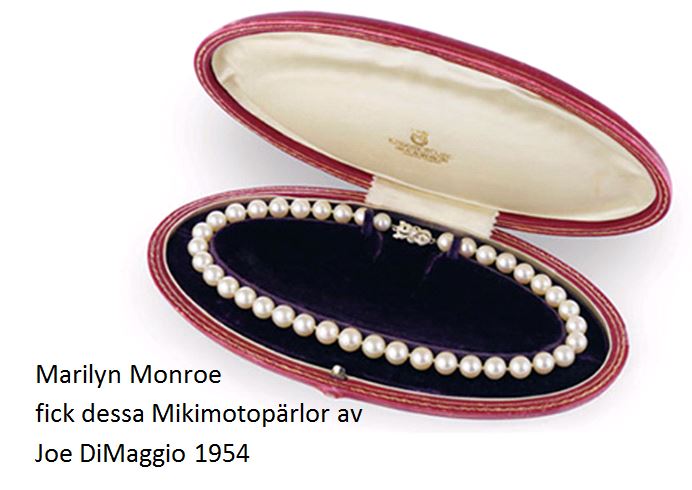
Marilyn Monroe received this Mikimoto Akoya necklace from Joe DiMaggio in 1954 as a honeymoon gift.

Mikimoto's first pearl jewelry store opened in Tokyo's fashionable Ginza shopping district in 1899.
In 1913, Mikimoto established its first store in London and today has stores in all the world's shopping metropolises.

Bond Street, London
Mikimoto has jewellery of the highest class and today also uses other pearl species than Akoya such as South Sea pearls (Pinctada Maxima) and Tahitian pearls (Pinctada Margaritifera).
Akoya pearl's quality assessment:
The quality of pearls is judged mainly on the luster of the surface, evenness, roundness and the intensity of the color tone.
It must be remembered that even with a cultured pearl, it is a mussel that creates the pearl and we can only hope for a pearl that in our opinion is "perfect".
We use a system with four classes: Standard quality, A, AA, AAA.
"Standard quality"
The whole pearl is beautiful, but there are no strict requirements that there should be no irregularities or that there should be no "dragon tail".
The pearls that have irregularities in the surface are much easier to have a beautiful luster and they give a lively impression.
"A-quality"
There is almost no dragon tail, but a careful examination shows that there are variations in the surface of the pearl. The luster is slightly lower than "AA" and "AAA".
Most people would rate these pearls as perfect.
"AA quality"
These are pearls of very high quality. Some experience is needed to discern what does not allow a third "A".
"AAA quality"
Our highest quality, the pearls are very carefully chosen.
The luster is very high, the surface almost perfect, very high roundness and beautiful colour tone.
Our Akoyarings, earrings and pendants are almost exclusively of this quality.
No two pearls are identical, not even on a necklace where you can not see any difference between the pearls with your eye. If you examine carefully enough, there are differences.
The assessment criteria can also not be ranked with measuring instruments.
The quality rating is very much based on experience and how used to judging pearls.
"Hanadama" is the name of a classification used in Japan for the best pearls. Hanadama means "spherical flower" and is issued by the Pearl Science Laboratory, Tokyo. To be Hanadama, a certificate must follow the pearls.
Quality criteria
Luster:
This is the most important property for all pearls, other quality criteria are more up to taste!
For pearl jewellery with white pearls smaller than 10mm, Akoyan is the pearl with the highest luster.
The Akoya pearl's luster is generally the highest of all pearl species, but the luster of Akoya pearls are also different from each other and necklaces are made with pearls that match in, among other things, luster.
Another pearl species with a high quality pearl can of course have a higher luster than an Akoya of lower quality.
The luster of the Akoya pearl increases when the water temperature is lower, so the harvest of pearls takes place mainly in the spring before the water temperature rises.
Colour shades:
It is said that the Akoya pearl is white but it has often has undertones. The classic special Akoyatone is white with a faint pink second colour tone.
It is also common for the Akoya to be completely white.
There are also citrus yellow tones, silver metallic tones and golden tones.
No hue is affecting the price more than any other hue. A clear and distinct colour tone makes the pearl more rare and thus increases the price.
We always have a large assortment of Akoya in the store, which is completely white and white with the pink "Akoya tone".
Usually we also have other colour tones but this depends entirely on what is available in the market.
Our pearls are not coloured. The pearls have their natural colours.
Pearl surface:
A clean smooth surface means that the quality of the pearl is ranked higher. All pearls have natural variations, but if you do not see any variations without magnification, the surface is considered perfect.
Roundness:
The Akoya pearl is naturally very round, but it has a peculiarity, so-called "Dragon's Tail" or "Dragontail". This is a small outgrowth on the otherwise round pearl. Beads with a dragon tail are classified as "Standard quality".
A, AA, AAA quality has no dragontail.

Akoya pearls in magnification with dragon tail. The drilling for the threading of the beads goes through the kite tail so that it is visible as little as possible.
Size:
The Akoya mussel is a small mussel with a diameter of about 8cm. This is the main reason why you do not get larger pearls than about 10mm.
Due to the size of the pearls, it is graded in 0.5mm intervals.
When the size of the bead is larger than 8mm, the supply of pearls becomes smaller and when they approach 10mm, they are very rare in high quality. This affects the price very quickly.
A pearl in AAA quality with a size of 10mm is a thousand times more rare than a pearl in A-quality in the same size.
Likewise, a pearl in AAA quality with a diameter of 10mm is a thousand times more rare than a pearl in AAA quality with a diameter of 8mm.
The largest pearls of the highest quality are saved by the growers for a long time to get complete necklaces with pearls that match well.